
Running a small business in 2026 isn’t easy. Rising operational costs, lean teams, and fierce digital competition mean owners must do more with less.
That’s where the 17 Best AI productivity tools for Small Business come in.
Modern AI software acts like a digital employee handling emails, writing content, automating invoices, summarizing meetings, forecasting sales, and even helping you plan strategy. The best part? Many of these tools cost far less than hiring additional staff.
Running a website alone sounds exhausting, especially when it’s an AI tools directory like BotBunch, where research, writing, design, updates, SEO, and publishing never stop.
But here’s the truth:
👉 I manage BotBunch as a solo creator, and AI tools are the reason it’s possible.
Instead of hiring a big team, I rely on smart automation and productivity software like ChatGPT, Canva, Google Gemini, and ILoveWords.io to handle everything from blog posts to thumbnails and SEO optimization.
In this complete guide, you’ll learn:
✔ Why AI matters for small businesses in 2026
✔ How to adopt AI step by step
✔ The best AI tools by category
✔ Starter-to-advanced tool stacks
✔ Costs, mistakes to avoid, and future trends
Whether you run an agency, e-commerce store, local service, or SaaS startup, this article will help you work smarter, scale faster, and stay competitive.
Why AI Productivity Tools Matter for Small Businesses in 2026?
Small businesses are embracing AI faster than ever and for good reason.
Here’s what the right tools can do:
- ⏱ Save 10–30 hours per week by automating repetitive work
- 👥 Reduce the need for extra hires
- 📣 Speed up marketing and sales
- 📊 Deliver better data-driven decisions
- 💸 Offer affordable SaaS pricing compared to full-time employees
Today, most SMBs already use at least one AI tool, often for writing or customer support. In 2026, we’re seeing a new wave of AI agents replacing admin tasks, managing workflows, and proactively suggesting improvements.
Step-by-Step Process to Adopt AI in Your Small Business
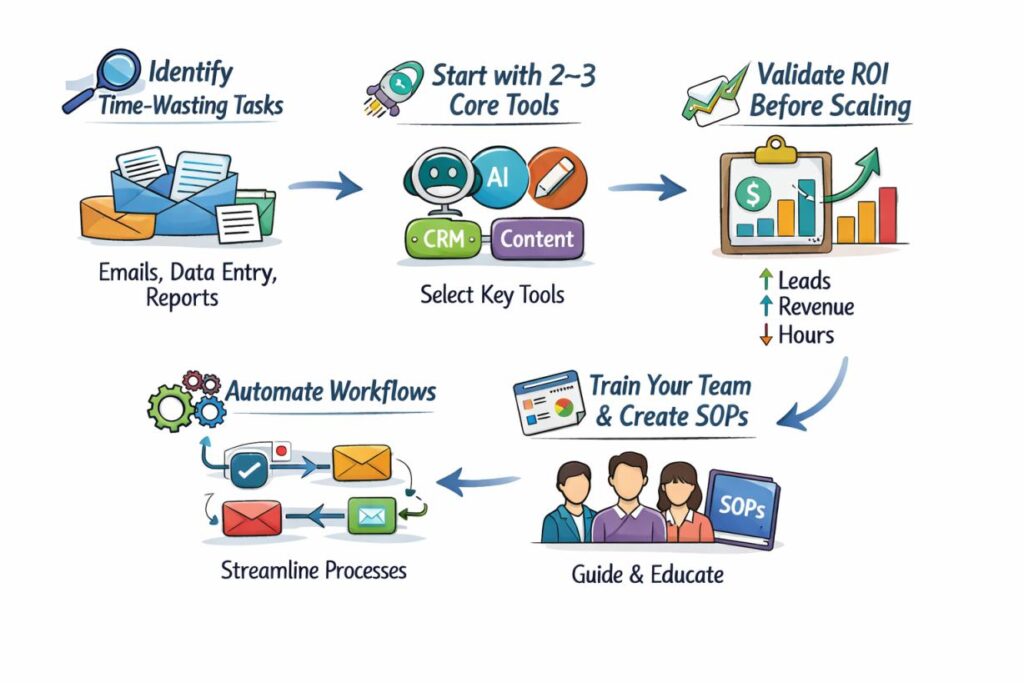
Jumping into AI without a plan can waste money. Follow this simple framework instead.
Step 1: Identify Time-Wasting Tasks
Start by listing activities that consume hours each week:
- Answering emails
- Manual data entry
- Writing blog posts or social captions
- Scheduling meetings
- Handling support tickets
- Preparing reports
These repetitive processes are perfect for automation.
Step 2: Start With 2–3 Core Tools
Avoid buying too many tools at once.
Choose based on your biggest pain point:
- Marketing heavy? → Writing + design tools
- Finance heavy? → Invoicing + forecasting AI
- Operations heavy? → Automation + SOP generators
Master a small stack before expanding.
Step 3: Validate ROI Before Scaling
Track real results:
- Hours saved per week
- Leads generated
- Conversion rates
- Monthly revenue impact
If a tool isn’t paying for itself, replace it.
Step 4: Automate Workflows
Connect your tools to create hands-free systems:
- Zapier workflows
- AI agents managing tasks
- CRM auto-updates
- Invoice → email → follow-up sequences
Automation is where the biggest productivity gains appear.
Step 5: Train Your Team and Create SOPs
AI works best when everyone knows how to use it.
- Build a prompt library
- Maintain an internal wiki
- Document processes in Notion
- Hold weekly AI reviews
This keeps your workflows consistent and scalable.
17 Best AI Productivity Tools for Small Businesses in 2026 (By Category)
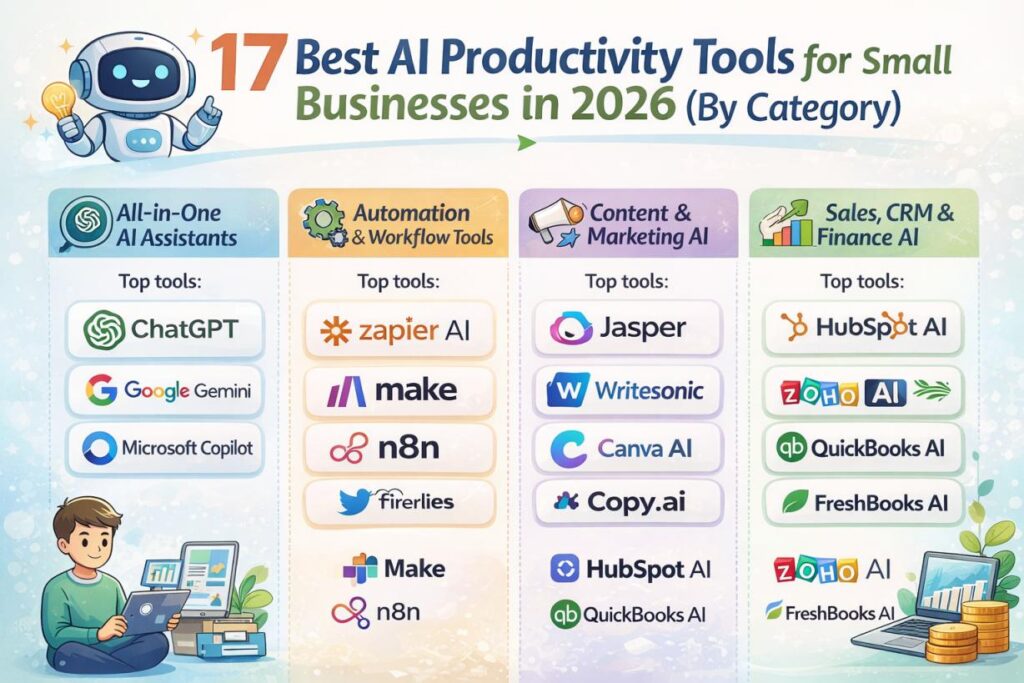
Let’s explore the most useful tool types and top picks in each.
All-in-One AI Assistants
Top tools: ChatGPT, Google Gemini, Microsoft Copilot
Best for:
- Writing emails and proposals
- Research and planning
- Drafting SOPs
- Brainstorming ideas
These assistants act as your everyday business copilots.
Automation & Workflow Tools
Top tools: Zapier AI, Make, n8n
Best for:
- Lead routing
- CRM updates
- Invoice automation
- App-to-app workflows
Perfect for reducing manual work across departments.
Content & Marketing AI
Top tools: Jasper, Writesonic, Canva AI, Copy.ai
Best for:
- SEO blog writing
- Ad copy
- Social media posts
- Video scripts
- Visual designs
Great for agencies, bloggers, and online brands.
👉 Bonus Productivity Tool:
ILoveWords.io — Free word counter and website text analyzer for bloggers, marketers, and small businesses optimizing AI-generated content.
Meeting & Communication Tools
Top tools: Fireflies, Otter-style assistants, Granola
Best for:
- Transcribing calls
- Generating summaries
- Creating follow-ups
- Logging action items
These tools eliminate note-taking and missed details.
Sales, CRM & Finance AI
Top tools: HubSpot AI, Zoho AI, QuickBooks AI, FreshBooks AI
Best for:
- Lead scoring
- Customer chatbots
- Automated invoicing
- Revenue forecasting
- Budget tracking
They combine productivity with profitability.
👉 9 Best AI Voice Generator Tools in 2026: Complete Guide to Natural-Sounding AI Voices
👉 Kling AI Video Generator Review 2025: Is It Really Worth It?
Recommended AI Tool Stack for Small Businesses
Not sure where to start? Use these ready-made setups.
🟢 Starter Stack (Solo Founder)
- ChatGPT
- Canva AI
- Notion AI
Perfect for freelancers, creators, and new entrepreneurs.
🟡 Growth Stack (5–20 Employees)
- Microsoft Copilot or Google Gemini
- Zapier
- HubSpot AI
- Fireflies
Great for scaling operations and sales.
🔴 Advanced Stack (Automation-First Company)
- Custom AI agents
- n8n automation
- CRM AI systems
- Accounting AI
- Real-time dashboards
Built for serious efficiency and long-term scale.
How Much Do AI Productivity Tools Cost in 2026?
Most tools fall between:
💲 $15–$100 per month per tool
Typical budgets:
- Starter setup: Under $150/month
- Growing business: $200–$500/month
Compare that to hiring a full-time employee, and the ROI becomes obvious.
Example:
If automation saves 20 hours a week and your time is worth $25/hour, that’s $2,000/month in value, far more than your tool spend.
Common Mistakes Small Businesses Make With AI
Avoid these costly errors:
❌ Buying too many tools
❌ Skipping team training
❌ Not automating workflows
❌ Failing to track KPIs
❌ Blindly trusting AI outputs
AI should assist, not replace human judgment.
How to Choose the Right AI Tools for Your Business?
Before subscribing, ask:
✔ Does it fit my industry?
✔ Does it integrate with my current apps?
✔ Is pricing reasonable?
✔ Are security and privacy strong?
✔ Is support responsive?
✔ How steep is the learning curve?
✔ Is there a free trial?
Smart selection prevents churn and wasted budgets.
How AI Adoption Looks Across Different Business Ecosystems?
Not every business uses AI the same way. Adoption depends on industry, team size, and daily operations.
Here’s what it looks like across major ecosystems:
🛒 E-commerce Businesses
Use AI for:
- Product descriptions
- Pricing optimization
- Inventory forecasting
- Chatbots
- Review analysis
🏢 Local Service Providers
Plumbers, clinics, agencies, and consultants rely on AI for:
- Appointment booking
- WhatsApp chatbots
- CRM automation
- Invoice generation
- Local SEO content
📢 Marketing Agencies & Creators
AI helps with:
- Blog writing
- Social posts
- Video scripts
- Thumbnails
- Keyword research
🧾 Accounting & Finance Firms
Adopt AI for:
- Expense tracking
- Tax assistance
- Fraud detection
- Financial forecasting
🚀 Startups & SaaS Companies
Use AI for:
- Customer onboarding
- Bug detection
- Market research
- Support tickets
- Product roadmaps
How to Use AI for Productivity in a Small Business?
Productivity is where most SMBs see the fastest returns.
Here are simple ways to use AI every day:
📧 Email & Communication
- Draft replies
- Summarize threads
- Create proposals
- Follow-ups
📝 Content Creation
- Blog posts
- Ads
- Landing pages
- Social captions
📊 Admin Work
- Generate reports
- Create SOPs
- Analyze spreadsheets
- Meeting summaries
📅 Scheduling & Planning
- Calendar automation
- Task prioritization
- Weekly plans
Future Trends: What AI Productivity Will Look Like After 2026
Here’s what’s coming next:
- 🤖 Autonomous AI agents managing departments
- 🎙 Voice-first business workflows
- 📊 Predictive operations dashboards
- 🎯 Hyper-personalized marketing
- 🧠 Industry-specific AI tools
Early adopters will gain a massive edge.
Final Thoughts: Start Small, Scale Smart With AI
AI isn’t about replacing people; it’s about freeing your team to focus on growth.
- Start with one pain point.
- Test a few tools.
- Measure results.
- Automate what works.
- Scale confidently.
👉 Explore our AI tools directory
👉 Join our newsletter for weekly AI insights
If you’re serious about building a future-proof business in 2026, AI productivity tools aren’t an option; they’re essential.
FAQs
-
What are AI productivity tools for small businesses?
AI productivity tools are software platforms that use artificial intelligence to automate repetitive tasks, assist decision-making, and improve daily operations like marketing, finance, customer support, and scheduling.
-
Which AI tools should small businesses start with in 2026?
Most small businesses should begin with an all-purpose assistant like ChatGPT or Copilot, a design tool such as Canva AI, and an automation platform like Zapier.
-
How much do AI tools cost for small businesses?
Most AI productivity tools range from $15 to $100 per month. A starter stack can often stay under $150 monthly while delivering significant time savings.
-
Are AI tools safe for business data?
Reputable platforms provide encryption, compliance features, and admin controls. Always check privacy policies, certifications, and data-handling terms before adoption.
-
Can AI replace employees in small businesses?
AI is best used to assist teams rather than replace them. It automates routine work so staff can focus on strategy, creativity, and customer relationships.
-
What industries benefit most from AI productivity tools?
Marketing agencies, e-commerce stores, SaaS startups, consultants, local service providers, and online creators see the biggest productivity gains from AI adoption.