What if there was an AI that didn’t sugarcoat things? An AI that gives you real-time information, straight from the internet, right now, as it happens. An AI that’s a little rebellious, a little witty, and refreshingly honest.
Meet Grok AI.
In this article, we’re doing a complete, no-fluff breakdown of Grok AI in 2026 — what it is, how it works, its best features, its real weaknesses, how much it costs, who’s using it, and whether it’s actually worth your time.
Let’s get into it.
What Is Grok AI?
Grok is an AI chatbot built by xAI, a company founded by Elon Musk in 2023. The name “Grok” comes from a classic science fiction novel, Stranger in a Strange Land, and it means to understand something so deeply that you become one with it.
Poetic? A little. But there’s a real philosophy behind it.
Musk’s stated goal with xAI was to build an AI that genuinely tries to understand the universe, one that’s curious, truthful, and refuses to be politically filtered.
The AI world already had ChatGPT. It had Claude. It had Gemini. So what made Grok different from day one?
Three things.
Number one: Real-time knowledge. Most AI chatbots are trained on data up to a certain date, and that’s it. Grok? It pulls live information from the web and directly from X, formerly Twitter.
Number two: X integration. Grok AI lives inside one of the world’s biggest social platforms, giving it access to hundreds of millions of posts, conversations, and trending topics in real time.
Number three: Personality. Grok AI was designed with a sense of humour, inspired by the Hitchhiker’s Guide to the Galaxy, and is notably more willing to engage with edgy, controversial, or sensitive topics than its competitors.
That combination of traits has made it one of the fastest-growing AI platforms on Earth.
Grok AI – Features
Let’s break down exactly what Grok AI can do, because this is where it earns its reputation.
1. REAL-TIME INFORMATION:
Most AI tools have what’s called a “knowledge cutoff”, a date beyond which they don’t know what happened.
Grok AI powerfully sidesteps this. It uses live web search and real-time X data to give you current answers.
Ask it about breaking news, yesterday’s stock market, today’s trending hashtags, and it’ll pull it in real time.
For journalists, traders, researchers, or just news junkies, this is huge.
2. THE CONTEXT WINDOW — 2 MILLION TOKENS:
This one is for the developers and power users in the room.
Grok AI offers a 2-million-token context window. Let me put that in plain English.
A “token” is roughly 0.75 words. So 2 million tokens is roughly 1.5 million words, the equivalent of about six full novels, in a single conversation.
ChatGPT’s context window? Around 128,000 tokens. Claude’s? Around 200,000.
Grok’s 2-million-token window is a genuine technical differentiator, especially if you’re working with massive documents, long codebases, or complex research projects.
3. FOUR THINKING MODES
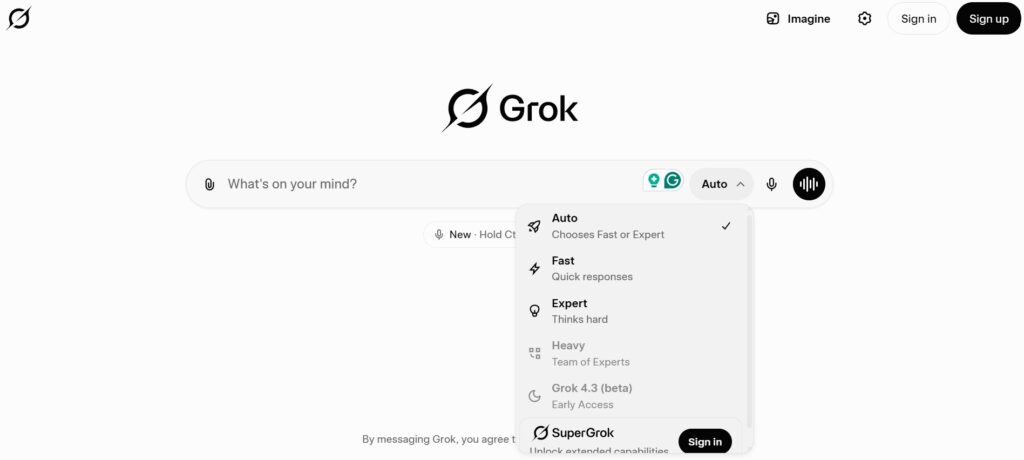
One of Grok’s most interesting design choices is its four operating modes:
- Auto Mode — Grok picks the best approach for your question. Great for everyday use.
- Fast Mode — Prioritizes speed. Ideal for quick questions, casual chat, and simple lookups.
- Expert Mode — Extended thinking. Grok reasons more carefully before responding. Best for complex problems.
- Heavy Mode — The flagship premium feature. It deploys multiple AI sub-agents working in parallel to tackle complex, multi-step tasks. Think of it like having a whole research team, not just one assistant.
4. IMAGE GENERATION
Grok includes built-in AI image generation called Aurora. No need to jump to a separate tool like Midjourney or DALL-E. Type a description, get an image, right inside Grok.
5. VOICE MODE
Grok also supports voice conversations, letting you talk to it like a person, not just type at it. The voice mode includes multiple voice options and feels natural for mobile and hands-free use.
6. CODE EXECUTION
Developers, listen up. Grok AI has a built-in Python REPL environment, meaning you can write code AND run it directly inside your chat. It supports libraries like NumPy, SymPy, and PyTorch.
No switching tabs. No setting up a local environment. Just write, test, and iterate — all in one place.
7. DEEPSEARCH
DeepSearch is Grok’s advanced research mode. Instead of one quick answer, it actively browses the web, synthesizes multiple sources, and returns a comprehensive, cited response.
It’s especially powerful for trend analysis, social listening, competitive research, or any topic where you want depth, not just a surface-level reply.
The Numbers — How Big Is Grok AI?
Before we dive into the features, let’s talk about scale, because the numbers here are genuinely wild.
Monthly Active Users: As of early 2026, Grok has approximately 64 million monthly active users, a figure confirmed by xAI and backed by third-party analytics.
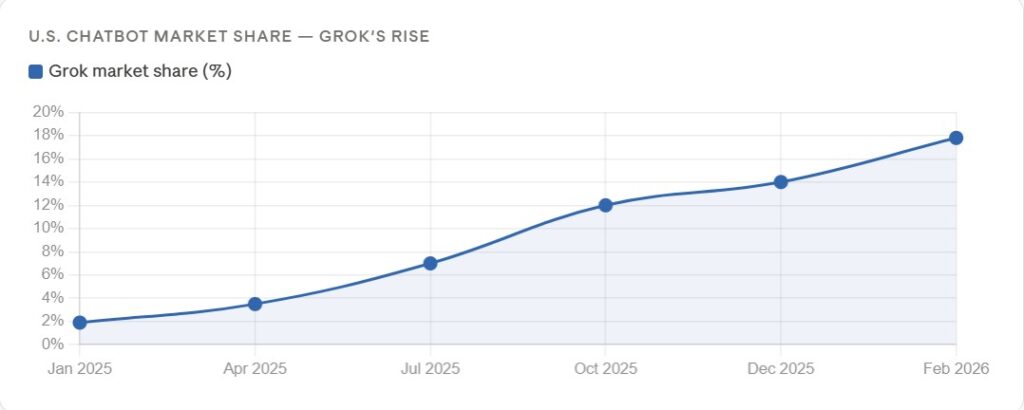
To give that context: Just one year earlier, in January 2025, Grok’s U.S. market share was 1.9%. By February 2026? It had shot up to 17.8%. That’s nearly a 10x increase in market share in twelve months.
Web Traffic: In February 2026, grok.com recorded 298.6 million monthly visits, with users spending nearly 13 minutes per session on average.
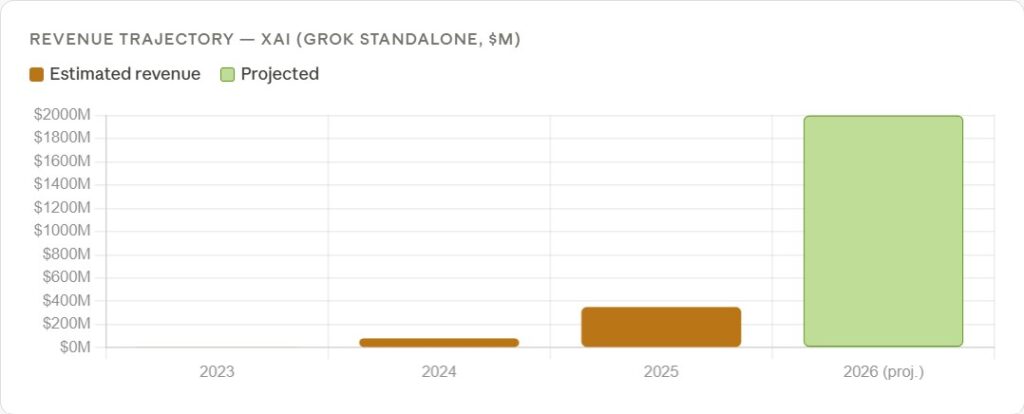
Revenue: xAI doesn’t release official revenue figures, but estimates from analysts suggest the company brought in around $350 million in 2025, with projections of up to $2 billion in standalone revenue for 2026.
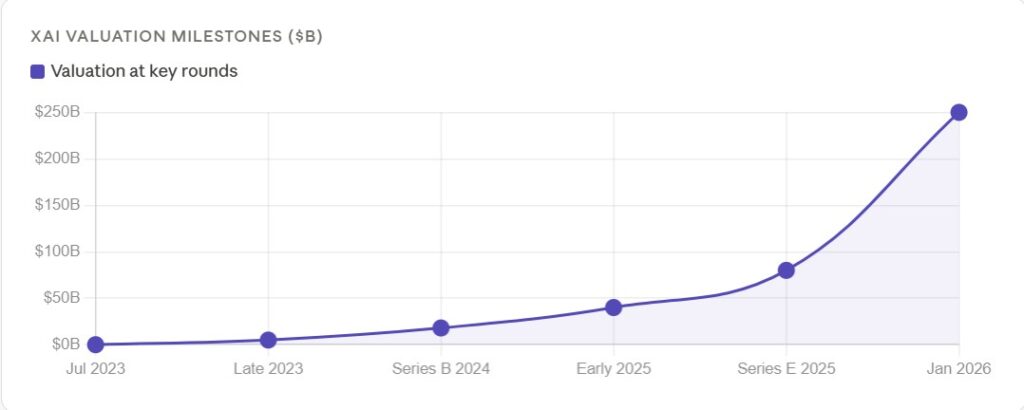
Valuation: Here’s where it gets jaw-dropping. xAI merged with X in 2026, and the combined entity was valued at $250 billion, with some reports placing it even higher after its January 2026 funding round of $20 billion.
That makes xAI one of the fastest companies in history to reach a $20 billion valuation, doing it in under two years.
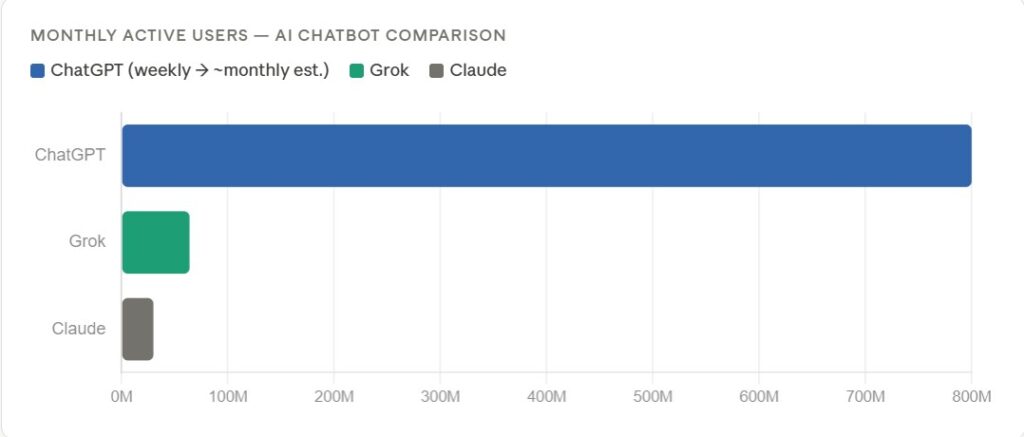
Now, for perspective, ChatGPT still leads with around 800 million weekly active users. Claude sits at around 30 million monthly. Grok is catching up, but it’s still a challenger brand.
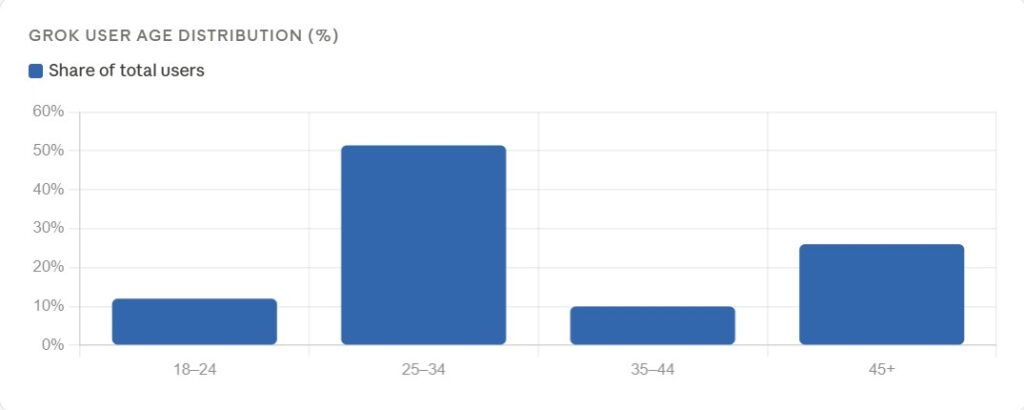
User Age Distribution: Over 63% of Grok’s users are under 35, making it one of the youngest-skewed AI platforms. Yet the strong 45+ presence (26%) signals real utility beyond just tech-savvy youth.
Grok AI – Pros and Cons
Pros
| Point | Explanation | Best For / Impact |
|---|---|---|
| Real-time Data | Pulls data from live web + X simultaneously | Time-sensitive research, news tracking |
| Massive Context Window | Supports up to 2 million tokens | Large documents, long codebases, deep research |
| Less Filtered Responses | Handles controversial or nuanced topics more openly | Unfiltered opinions, exploratory discussions |
| Competitive Pricing | Free tier + affordable plans + cheaper API | Budget users, startups, developers |
| Built-in Tools | Image generation, voice mode, code execution, DeepSearch | All-in-one AI workflows |
| Distribution Advantage | Integrated with X | Massive reach, easy adoption |
Cons
| Point | Explanation | Limitation |
|---|---|---|
| X Dependency | Best features tied to X usage | Less useful for non-X users |
| Weaker Creative & Coding | Behind Claude (writing) and GPT-4o (coding) | Not best-in-class for those tasks |
| Less Developer-Friendly | Newer API, fewer tools and integrations | Limited dev ecosystem |
| Content Controversy | Less filtering can lead to unpredictable outputs | Risk in professional/neutral use |
| Young Ecosystem | Built by xAI (founded 2023) | Still maturing vs competitors |
Grok AI – Use Cases
So who should actually be using Grok? Let’s break it down by person type.
Journalists & Researchers: If your work requires staying on top of breaking news, trending narratives, or analyzing public discourse, Grok’s real-time X data and DeepSearch are a genuine superpower. This is probably Grok’s strongest use case.
Entrepreneurs & Marketers: Competitive research, trend spotting, content ideation, campaign analysis, Grok AI handles all of this well. The integration with social data gives marketers a real-time pulse on what’s resonating.
Developers: The 2-million-token context window and built-in code execution make Grok AI compelling for developers who work with large codebases or need rapid prototyping. The API pricing is competitive, too.
Students: The free tier is genuinely useful for studying, research, and essay drafting. Grok AI also has a more conversational, less robotic personality, which makes learning feel less like reading a textbook.
Business Analysts: Summarizing large reports, parsing financial documents, synthesizing multi-source research, the 2M context window makes Grok AI exceptional for document-heavy professional workflows.
Content Creators: Between the image generation, voice mode, and research tools, content creators can ideate, produce, and research inside a single platform.
Grok AI – Pricing
Grok AI is now paid
Two plans, both discounted 50% for the first 2 months. Here’s what you get.
Limited offer — 50% off for the first 2 months on both plans
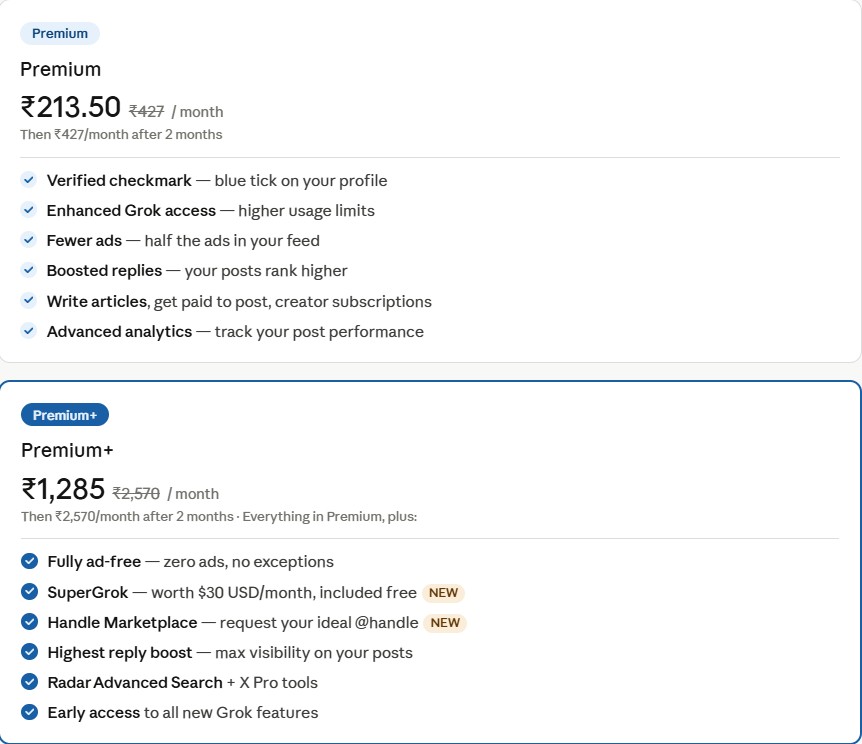
Premium [₹213.50/mo ($2.28) for 2 months, then ₹427 ($4.57)] — solid for casual users who want the blue tick, fewer ads, Grok access, and creator tools like paid posts and articles.
Premium+ [₹1,285/mo ($13.72) for 2 months, then ₹2,570 ($27.52)] — the power-user plan. The star feature is SuperGrok included free — that alone is worth ~$30 USD/month separately. Add zero ads, the highest reply boost, Handle Marketplace, and X Pro tools, and it’s a serious value for active creators and researchers.
Grok’s API pricing is competitive and can offer up to 40% cost savings compared to models like GPT-4o for similar tasks.
Note: Subscription plans, pricing, and features may change at any time. For the most current and accurate information, visit x.com/premium before subscribing.
Grok AI – ALTERNATIVES
Let’s put Grok AI in context with the competition.
Grok vs. ChatGPT: ChatGPT still leads in raw user base, plugin ecosystem, and creative writing. But Grok AI wins on real-time data, context window size, and API cost-efficiency. For most everyday users, ChatGPT is still the safer default. For news, research, and social data? Grok has an edge.
Grok vs. Claude: Claude is widely considered the best AI for nuanced writing, thoughtful reasoning, and complex conversations. Grok beats it on real-time access and context window. If your work is document-heavy or writing-focused, Claude might still be your go-to.
Grok vs. Google Gemini: Gemini has the advantage of deep Google ecosystem integration — Gmail, Docs, Search. Grok has the advantage of X integration and a less filtered personality. They serve slightly different ecosystems.
Grok vs. Perplexity AI: Perplexity is built specifically for research and real-time search; it’s Grok’s most direct competitor in that niche. Perplexity is arguably cleaner for pure research tasks; Grok offers more versatility across use cases.
FINAL VERDICT — Is Grok AI Worth It?
So, after everything, is Grok worth your time in 2026?
Here’s the honest verdict:
If you want the best all-around AI assistant for everyday tasks, ChatGPT or Claude are still safer bets.
If you want real-time information, social data, large document processing, or competitive API pricing, Grok is genuinely excellent and worth using.
If you’re on X already and pay for Premium, Grok is already included. There’s literally no reason NOT to use it.
If you’re a developer or entrepreneur, the premium tier is worth testing right now. The 2M context window alone might change how you work.
The most impressive thing about Grok AI isn’t any single feature. It’s the trajectory.
Going from 1.9% U.S. market share to 17.8% in a single year. Going from zero to a $250 billion valuation in under three years. Going from a side project to a government-contracted AI platform.
Whatever you think of the personality behind it, the product is moving fast, and the numbers back it up.
Ta! Da!

About Naseeb Akhter
The founder of BotBunch, where he researches, tests, and reviews the latest AI tools, automation software, and SaaS platforms. Along with the BotBunch editorial team, he helps creators, students, professionals, and businesses discover the best AI solutions through hands-on testing, honest reviews, detailed comparisons, and easy-to-follow guides.
Join us via email and social channels to get the latest updates straight to your inbox.